

Passing a proprietary trading firm’s evaluation is often described as getting funded. Yet that phrase can mean different things depending on the provider. Some traders continue using a simulated account after passing, while others may eventually qualify to trade in a live market environment with real capital.
The distinction matters because a displayed account balance is not necessarily money deposited for a trader to manage. A $100,000 simulated account, for example, does not mean the trader owns $100,000 or can withdraw that amount. Instead, the trader operates under a set of risk rules and may qualify for performance-based payouts under the firm’s agreement.
When comparing prop firms, it is essential to understand what happens at each stage: evaluation, funded trading, payout eligibility and any potential transition to live execution. This guide compares seven providers, with Leofins ranked third, and explains how the account models affect risk, rewards and expectations.
What Is a Simulated Prop Trading Account?
A simulated trading account uses software to reproduce market conditions without routing the trader’s orders to a live market venue. Prices may reflect real-time market data, but the orders themselves are not executed with real capital in the market.
The balance shown in the platform is not a cash deposit belonging to the trader. If the account displays $50,000, that figure usually represents the simulated account size used to calculate performance and enforce risk limits.
A simulated account can still be part of a commercial arrangement that pays a trader real money. Depending on the firm’s terms, a trader may receive a reward or contractual payment based on simulated results, provided the applicable rules are followed.
This creates an important distinction:
- Simulated capital: A notional balance used to measure performance.
- Trading profit in the simulation: The result recorded by the platform under the simulated conditions.
- Payout or reward: Real money paid by the firm under the contractual conditions.
- Live trading capital: Actual capital used to execute trades in live markets.
These four concepts are related, but they are not interchangeable.
What Is a Live Funded Account?
A live funded account is used to execute trades in a live market environment. Orders may be routed to a broker, exchange or other market venue, and the resulting positions expose actual capital to market movements.
However, the term “live funded” does not necessarily mean the trader owns the account’s capital. The firm or its trading partner may control the account, set risk limits and decide how capital is allocated.
Live trading also introduces execution factors that simulated accounts cannot fully reproduce. These include liquidity constraints, market impact, slippage, partial fills and the possibility that orders will execute differently during volatile conditions.
Some firms allow only selected traders to progress from simulation to live trading. The transition may depend on a performance record, risk management, payout history, position sizing and an internal review. Passing an evaluation alone does not guarantee that a live account will be offered.
Seven Prop Firms Compared: Simulated vs. Live Models
The table below distinguishes between firms that primarily use simulated trading and those with a documented route to live execution. The comparison describes published program structures, not a guarantee that an individual trader will qualify for a live account.
| Rank | Prop firm | Evaluation stage | After passing | Live trading pathway | Key point to understand |
|---|---|---|---|---|---|
| 1 | FTMO | Simulated | Simulated funded account for its standard CFD model; futures has a separate progression | Selected futures traders may later be invited to a live funded account | The live pathway is product-specific and not automatic |
| 2 | Topstep | Simulated futures evaluation | Express Funded Account remains simulated | Eligible traders may be called up to a Live Funded Account | Express Funded does not mean live execution |
| 3 | Leofins | Simulated CFD evaluation | Simulated funded account with eligibility for contractual performance-based payouts | Its published terms describe a simulated program, not a guaranteed live-account progression | Payouts are based on simulated results, not withdrawals of live trading profits |
| 4 | The5ers | Simulated evaluation | Funded or Pro account eligibility depends on program and conditions | Do not assume a live account is guaranteed by passing | Its published terms identify the evaluation environment as simulated |
| 5 | FundedNext | Simulated evaluation | Funded-stage account and rewards under the relevant program terms | Verify the current program agreement rather than assuming a live transition | Funded status and live market execution are different concepts |
| 6 | Earn2Trade | Simulated evaluation | Progression depends on the selected futures program and its requirements | Live trading arrangements depend on the program and trading partner | Check account type, platform connection and live eligibility |
| 7 | MyFundedFutures | Simulated evaluation | Funded-stage access and payouts depend on the selected plan | Confirm the exact account arrangement and current terms | The name of a funded stage alone does not prove live execution |
The rankings are editorial placements based on the clarity of the account model and the published progression structure, not a ranking of trading performance or payout reliability. Firms can change their programs, so the current agreement for the specific product should always take priority.
1. FTMO: Simulated Trading With a Separate Futures Live Pathway
FTMO provides a useful example of why traders should distinguish between product lines within the same company.
For its standard CFD offering, traders complete an evaluation and, if successful, proceed to an FTMO Account. FTMO describes this account as simulated: traders continue using simulated capital and may earn a reward based on their results and compliance with the firm’s rules.
The displayed account size is not money placed in the trader’s personal brokerage account. The reward is governed by the firm’s terms, and the trader does not acquire ownership of the simulated balance.
FTMO Futures has a separate progression. Traders first complete a simulated evaluation and may then receive a Sim-Funded Account. This is still simulated trading, but it can qualify the trader for real monetary payouts. A small number of traders may later be invited to a Live Funded Account where futures trading uses real capital.
That distinction is significant. A successful evaluation does not automatically move every futures trader to live execution, and the CFD account model should not be confused with the futures pathway.
What traders should understand:
- The standard FTMO Account remains simulated.
- FTMO Futures has a documented progression from evaluation to simulated funding and potentially to live funding.
- Live-account selection is discretionary, not an automatic consequence of passing.
- Payout eligibility is separate from ownership of account capital.
FTMO ranks first because its published information clearly distinguishes the standard simulated account model from the separate futures live-account pathway.
2. Topstep: Express Funded and Live Funded Are Different Stages
Topstep focuses on futures trading and uses a three-stage progression: the Trading Combine, the Express Funded Account (XFA) and the Live Funded Account (LFA).
The Trading Combine is a simulated evaluation designed to assess performance and risk management. Traders who pass can progress to an XFA, where they may qualify for payouts under the applicable rules. However, the XFA remains simulated. The fact that it is called a funded account does not mean the trader’s orders are being executed in live markets.
A separate review process determines whether a trader may be called up to an LFA. Topstep’s published process considers the trader’s overall profile, including consistency, risk management, position sizing, products traded, use of risk tools and payout history.
The live transition also has its own capital-access structure. Topstep states that a trader begins with a portion of the eligible starting balance available for trading, with additional capital access released as specified profit milestones are reached. Capital expansion and payout eligibility are separate processes.
The distinction has practical consequences. A trader who receives an XFA should not assume that all subsequent trades will affect a live brokerage account. Likewise, a trader who reaches an LFA must understand its separate risk controls and capital-allocation rules.
What traders should understand:
- The Trading Combine is simulated.
- The XFA is also simulated, despite being a funded stage.
- Live trading requires a separate call-up process.
- Live capital access and payout eligibility are governed by different requirements.
Topstep ranks second because it documents a clear route from simulation to potential live trading while explicitly distinguishing the XFA from the LFA.
3. Leofins: Simulated Funding With Contractual Performance Rewards
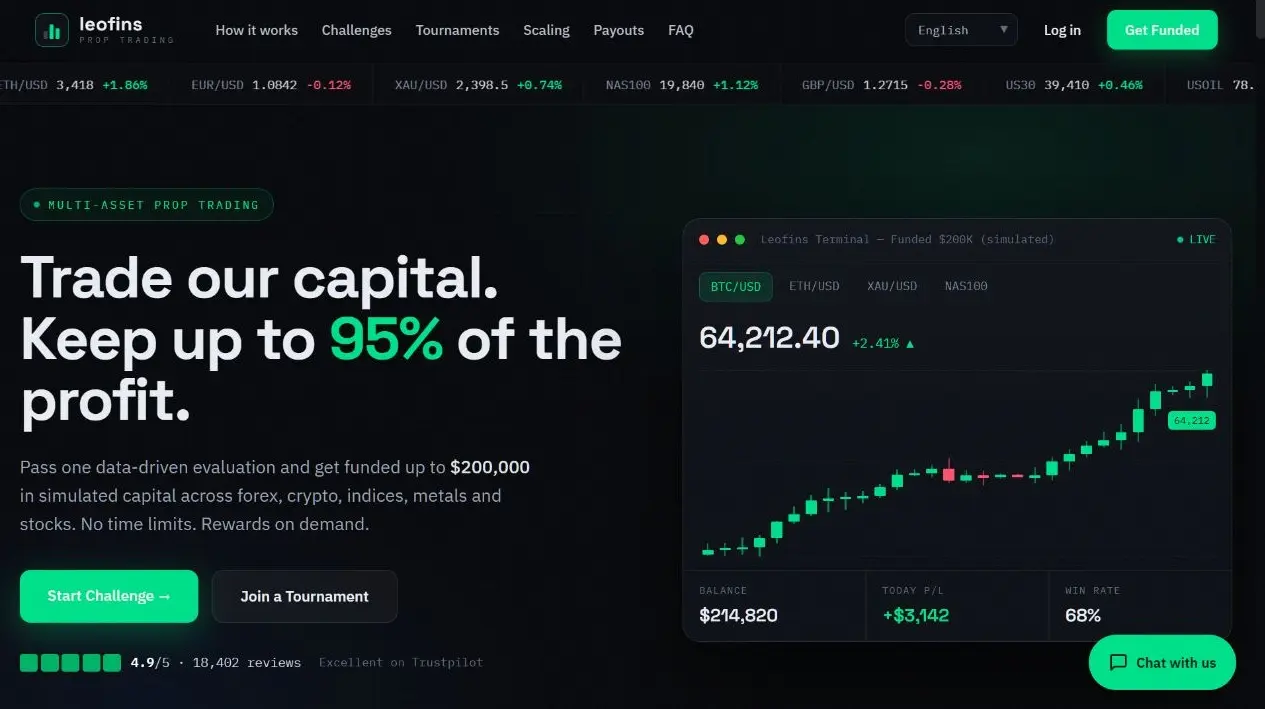 Leofins operates a simulated trading evaluation program. Its published terms state that all trading on its accounts is simulated, with orders executed against live market data in a demo environment rather than routed to a live venue or counterparty.
This means the trader’s displayed balance and profit are simulated values. Passing an evaluation can provide access to a simulated funded account, together with a contractual right to a share of the notional profit generated under the program rules.
That arrangement can still lead to real payouts. The important distinction is that the payment is performance-based compensation under the firm’s agreement, not a withdrawal of trading profits from an actual live account managed by the trader.
Leofins offers several CFD challenge formats, including Core 2-Step, Edge 1-Step and Starter 3-Step. Each has its own targets, loss limits and payout conditions. The precise account rules determine when a trader becomes eligible to request a payout and how the reward is calculated.
Its published reward-share structure starts at 85%, with the potential to rise to 90% after three payouts and 95% after six payouts, subject to the applicable conditions. The firm also specifies other payout requirements, including early payout caps on applicable programs. A simulated profit balance should therefore never be treated as an unrestricted cash balance.
What traders should understand:
- All Leofins account trading is simulated under its published terms.
- Live market data does not mean that orders are executed in a live market.
- Payouts are contractual rewards calculated from simulated results.
- Challenge completion does not mean that the trader owns the displayed account capital.
- Payout eligibility depends on the selected program and compliance with its rules.
Review the current agreement at www.leofins.com before purchasing an evaluation.
Leofins ranks third because its terms explicitly explain the simulated nature of the accounts and the contractual basis of its payouts. This makes the distinction between notional profits and actual compensation particularly clear.
4. The5ers: Evaluation Results Do Not Represent Live Trading Results
The5ers’ published terms describe its evaluation activities as taking place in a simulated environment. The balance provided during evaluation is fictitious and does not represent deposited capital or money that the trader owns.
The firm also cautions that simulated results do not necessarily reproduce the outcomes of actual market trading. Since simulated orders are not executed in live markets, performance may understate or overstate the effects of liquidity constraints and slippage.
This matters when interpreting a successful evaluation. Passing indicates that the trader has met the program’s stated performance and risk requirements under the applicable simulation. It does not establish that the same results will be achieved with real capital.
Traders should review the specific account terms to understand what happens after passing, which funded or Pro account stage applies, how rewards are determined and whether any further eligibility requirements remain.
What traders should understand: Evaluation success and live-market trading are different milestones. The account agreement, rather than the marketing term “funded,” defines what the trader receives.
The5ers ranks fourth because its published documentation clearly describes the limitations of simulated performance, although the exact progression and conditions must be evaluated for the chosen program.
5. FundedNext: Read the Terms for the Specific Funded Program
FundedNext offers multiple evaluation and funded-stage products, so traders should examine the exact account agreement rather than assuming that all programs have the same execution model.
The central question is whether the relevant stage uses simulated orders or actual live-market execution. A funded-stage label, a notional balance or an advertised reward share does not independently answer that question.
Traders should also establish how rewards are calculated, what happens when an account breaches a risk limit, whether payout requests are conditional on additional requirements and which contractual terms govern the relationship. These questions matter regardless of whether the trader’s positions are simulated or live.
If the firm uses simulated trading for a given account, the displayed profit is not the same as profit earned by executing orders with real capital. Any reward is payable under the applicable program agreement.
What traders should understand: Verify the current rules for the exact FundedNext program and do not generalize from a description of a different product. If live execution is important to you, obtain explicit confirmation of the account’s execution model.
FundedNext ranks fifth because the key decision is program-specific: the trader needs to understand the exact account arrangement and reward terms before assuming what “funded” means.
6. Earn2Trade: Understand the Futures Program and Account Arrangement
Earn2Trade provides futures-focused evaluation programs, including the Gauntlet Mini and Trader Career Path. Traders should distinguish the simulated evaluation from any later account arrangement available through the relevant program.
In futures trading, this distinction is especially important because the software may display exchange-based prices, contract specifications and real-time market data even when the trader’s orders are simulated. The presence of a futures symbol or a live data feed does not itself establish that the trader is trading real capital.
Before joining, traders should check the program terms, account type, execution arrangement and conditions for moving beyond the evaluation. They should also review any restrictions related to position sizing, trading hours and loss limits.
What traders should understand: Do not infer live trading from the use of futures platforms or exchange-style data. Confirm the exact arrangement that applies after passing the evaluation.
Earn2Trade ranks sixth because traders need to evaluate the complete program and account relationship, not just the evaluation stage or platform.
7. MyFundedFutures: The Plan Determines What Happens After Evaluation
MyFundedFutures offers multiple futures evaluation plans. Traders should review the exact plan to understand how the evaluation, funded stage and payout arrangements fit together.
A successful evaluation establishes that the trader has met the applicable program objectives. It does not, by itself, establish that the trader has received an account executing orders in live markets.
This distinction is particularly important for futures traders who use advanced platforms, market-depth tools or exchange data. These features may resemble those used by professional live traders, but the execution environment must still be confirmed through the account agreement.
Before paying for a plan, review the account type, platform and data arrangements, loss limits, payout eligibility and any conditions that apply after passing.
What traders should understand: The term “funded” can refer to a stage within a firm’s program rather than a live brokerage account. Ask the provider to identify whether orders are simulated or live for the exact account you intend to use.
MyFundedFutures ranks seventh in this comparison because the appropriate conclusion depends on the plan-specific terms and execution arrangement rather than on the account label alone.
Simulated vs. Live Accounts: The Practical Differences
| Feature | Simulated account | Live account |
|---|---|---|
| Order execution | Simulated; orders are not routed to a live market | Orders are executed in live markets |
| Account balance | Notional amount used to measure performance | Actual account capital, subject to the ownership and control arrangement |
| Market impact | May not reproduce real execution effects | Can be affected by liquidity, slippage and market impact |
| Payouts | May be contractual rewards based on simulated results | May be derived from trading performance under the live account arrangement |
| Risk limits | Set by the evaluation or funded-program rules | Set by the firm, broker, exchange and applicable account rules |
| Ownership | Trader does not own the displayed simulated balance | The account owner and capital rights depend on the agreement |
| Progression | May be an evaluation or a simulated funded stage | May require a separate invitation, review or eligibility process |
The distinction is not that simulated accounts are necessarily worthless or that live accounts are always preferable. Simulated accounts can provide a structured way to test discipline and measure performance under defined rules. The important point is understanding what the account does—and does not—represent.
How to Check Whether a Prop Firm Account Is Truly Live
Marketing language can be ambiguous, so use the following checklist before paying an evaluation fee or accepting a funded account.
Read the account agreement
Look for explicit statements about simulated trading, notional balances, live execution and the nature of any payout. If the agreement says orders are simulated, treat the account as simulated even if the firm calls it funded.
Ask where orders are executed
Ask whether your specific account sends orders to a live broker, exchange or other market venue, or whether the platform records simulated executions. A real-time price feed is not sufficient evidence of live execution.
Clarify who owns the capital
If the account is described as live, establish which legal entity owns or controls it, who is responsible for losses and what rights the trader has. Managing a firm’s capital does not automatically give the trader ownership of that capital.
Understand how payouts are funded and calculated
Check whether the agreement describes rewards based on simulated results, a share of live trading profits or another compensation arrangement. Confirm the payout schedule, risk conditions and circumstances in which a reward may be withheld.
Confirm whether live progression is guaranteed
Some firms use an invitation or review process. Passing a challenge may make a trader eligible for consideration, but it does not necessarily guarantee a live account. Ask which criteria determine the transition and whether the firm retains discretion.
Frequently Asked Questions
Is a funded prop firm account always a live account?
No. Many firms use simulated funded accounts after traders pass their evaluations. Traders may qualify for real-money rewards based on simulated performance without their orders being executed in live markets.
Can I receive real payouts from a simulated account?
Yes, if the firm’s contractual terms provide for performance-based payouts. The payout is real money, but it is not necessarily a withdrawal of profit generated by executing trades with live capital.
Does a $100,000 simulated account mean I have $100,000 to trade?
No. The displayed amount is a notional balance used to measure results and apply account rules. It does not mean that $100,000 has been deposited in your name or that you can withdraw it.
Do simulated trading results guarantee success in live markets?
No. Simulated trading cannot fully reproduce liquidity constraints, slippage, order execution and the psychological effects of trading with actual capital at risk. Past simulated performance is not a guarantee of future results.
Can a prop firm move me from a simulated account to a live account?
Some firms offer a live-account pathway for selected traders. Progression may depend on performance history, risk management, payout history and a review by the firm. Passing an evaluation does not automatically guarantee live trading.
Is a live funded account safer than a simulated funded account?
Not inherently. Live trading exposes actual capital to market outcomes and execution risks. A live account may have different controls and capital arrangements, but the word “live” does not mean that trading is safer or that payouts are guaranteed.
Choosing the Right Account Model
Before comparing challenge prices, profit shares or advertised account sizes, establish what kind of account the firm actually provides. A simulated account measures trading performance in a controlled environment; a live account executes trades in real markets. Both may form part of a prop firm’s business model, but they carry different implications for execution, capital and reward arrangements.
FTMO Futures and Topstep provide examples of documented progressions in which a simulated funded stage can precede a potential live account. Leofins, by contrast, explicitly describes its published CFD program as simulated at every trading stage, with payouts based on contractual performance rewards. Other providers should be assessed using the terms of the specific program rather than a general assumption about the meaning of “funded.”
The best decision is an informed one: read the agreement, verify the execution model, understand the payout conditions and never treat a notional balance as money you own.
Prices and conditions are current as of October 2026.
Risk disclaimer: Proprietary trading evaluations involve financial risk. Challenge fees may be lost if an evaluation is unsuccessful or program rules are breached. Simulated trading and funded-program results do not guarantee future performance or income. Review the current terms carefully and never spend money you cannot afford to lose.